Complete Guide to Selecting Mobile Lighting Towers
As a core lighting device for outdoor operations, emergency rescue, large-scale events, and other scenarios, the selection of mobile lighting towers must balance three core principles: scene adaptability, performance stability, and operational economy, avoiding blind pursuit of parameters or function stacking. Below is a systematic selection method covering four dimensions: demand analysis, key parameters, scene matching, and pitfalls to avoid.
Clarify Core Needs First to Determine Selection Direction
The premise of selection is to clearly define the usage scenario and core requirements. Priority needs vary significantly across different scenarios and can be sorted out in the following dimensions:
Scene and Operation Characteristics
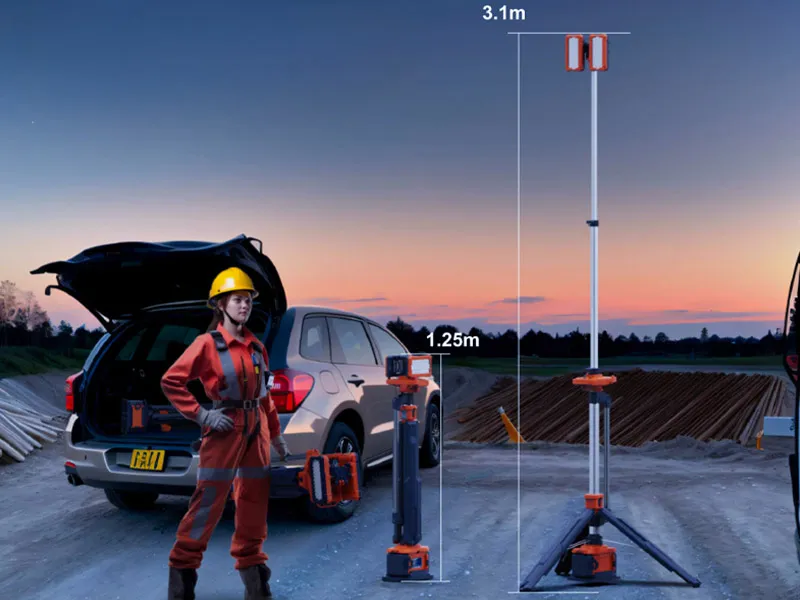
Operation Duration: For short-term temporary operations (such as emergency repairs and small-scale events), portability can be prioritized; for long-term continuous operations (such as mining and road construction), battery life and stability must be given top priority.
Environmental Conditions: For outdoor rainy, snowy, and dusty environments, pay attention to the protection level (IP65 or above is preferred); for low-temperature areas (below -20℃), select a power system with strong low-temperature starting capability; for noise-sensitive areas (residential areas, urban operations), prioritize electric or hybrid models.
Movement Frequency: For high-frequency movement scenarios (such as multi-point repairs and event transitions), hand-push or light trailer-type models are suitable; for long-term fixed-point use, heavy-duty trailer-type models can be selected to improve stability.
Core Lighting Requirements
● Coverage Range: Estimate the required irradiation radius based on the operation area. For small-scale maintenance (15-30 meters radius), choose 1-3kW small lighting towers; for large-scale infrastructure (over 80 meters radius), 15kW+ large high-pole lighting towers are required; 5-10kW medium-sized equipment is sufficient for conventional projects (40-80 meters radius).
● Lighting Precision: For precision operations (such as equipment maintenance and film shooting), cold white light with a color rendering index Ra≥80 and color temperature of 5500-6500K is required to ensure clear details; for foggy and nighttime outdoor operations, 3000K warm yellow light or metal halide lamps can be used to improve light penetration.
● Lighting Flexibility: For scenarios requiring precise coverage of specific areas, select models with lamp heads that can rotate 360° horizontally and adjust vertically. Some high-end models support switching between spotlight and floodlight modes, balancing long-distance projection and large-area coverage.
Analyze Key Parameters to Avoid Selection Mistakes
Lighting System Parameters
Lighting performance directly determines operation effectiveness, with three core indicators to focus on:
● Light Source Type: LED light sources are preferred, featuring high brightness (100-150 lumens/watt), long service life (≥50,000 hours), low energy consumption, and instant lighting, suitable for most scenarios; metal halide lamps have strong penetration and can be used as supplements for foggy and tunnel operations; traditional halogen lamps have high energy consumption and short service life, only recommended for temporary emergency use.
● Total Power and Luminous Flux: Power must match the coverage range, and higher power is not necessarily better — the fuel consumption of 20kW equipment is 60% higher than that of 10kW equipment, and 10kW is sufficient if only a 50-meter range needs to be covered. Luminous flux directly reflects brightness, requiring ≥180,000 lumens for conventional projects and ≥400,000 lumens for large venues.
● Lamp Pole and Lifting Mechanism: For every 1-meter increase in lamp pole height, the effective irradiation radius increases by 3-5 meters. 6-8m hydraulic lifting poles are suitable for conventional projects, and 10-12m electric lifting poles can be upgraded for large venues; hydraulic drive lifting is stable and accurately positioned, pneumatic type is more suitable for low-temperature environments, and manual adjustment is suitable for small portable models.
Power System Selection
The power system determines battery life and environmental adaptability, and the corresponding type should be selected according to the scenario:
● Diesel Power: Advantages include long battery life (some models can work continuously for 60-160 hours with a single fuel tank) and strong power, suitable for long-term outdoor operations without external power supply (such as mines and ports); disadvantages are high noise and emissions, requiring regular maintenance (oil change, filter cleaning), and not suitable for urban and residential areas.
● Electric Power (Lithium-ion/Lead-acid): Zero noise and zero emissions, suitable for urban operations, indoor scenarios, or noise-sensitive areas; battery life is limited by battery capacity, with conventional models working continuously for 4-6 hours, and fast-charging models are more suitable for high-frequency short-time operations; it is necessary to confirm in advance whether there is external power supply on-site.
● Hybrid Power (Mains + Diesel/Battery): Supports switching power supply modes, using mains power to reduce costs when external power is available, and starting diesel generators or batteries as backups when there is no power supply. It has the highest flexibility and is suitable for complex scenarios with unstable power supply (such as emergency rescue and large-scale events).
Movement and Stabilization System
● Movement Method: Trailer-type models (with standard hooks, towable by pickup trucks) are suitable for long-distance transitions, with a chassis ground clearance of ≥25cm to adapt to gravel roads; hand-push models (weight ≤50kg) are suitable for short-distance movement and multi-point temporary operations; vehicle-mounted models rely on truck transportation, suitable for fixed-route inspections and repairs.
● Stabilization Support: Stabilizing outriggers need to be deployed during operation. Hydraulic outriggers are more convenient to operate and more stable than manual outriggers. For extreme environments, models with anti-overturning warnings are recommended; the frame material is preferably Q345B alloy steel (impact-resistant) or lightweight aluminum alloy (easy to move).
Control and Protection Configuration
● Control Method: Local control panels are basic configurations. Wireless remote control (50-100 meters range) can improve operational safety and avoid personnel climbing; intelligent models support mobile APP control and remote status monitoring, suitable for scenarios requiring unattended operation or high-frequency adjustment (such as large-scale events and smart construction sites).
● Protection Level: For outdoor operations, the protection level of lamps and electrical control systems must be ≥IP54, and upgraded to IP65 or above for rainy, snowy, and dusty environments to prevent failures caused by water ingress and dust accumulation; for low-temperature environments, select electrical control boxes with thermal insulation functions to ensure normal startup.
Precise Scene Matching to Improve Selection Efficiency
1. Engineering Construction (Roads, Bridges, Infrastructure)
Core Needs: High brightness, large coverage, long battery life, and resistance to harsh environments. Recommended Configuration: 5-10kW LED light source + 6-8m hydraulic lifting pole + diesel-powered trailer-type lighting tower, IP65 protection level, hydraulic outriggers, wireless remote control, fuel tank capacity ≥40L (continuous operation ≥10 hours); for low-temperature areas, pneumatic lifting poles and low-temperature starting diesel generators can be selected.
2. Emergency Rescue (Earthquakes, Floods, Accident Repairs)
Core Needs: Rapid deployment, portability, multiple power backups, and wind/rain resistance. Recommended Configuration: 3-5kW LED light source + hydraulic lifting pole (deployment time ≤5 minutes) + hybrid power system, supporting quick folding, IP67 protection level, equipped with multiple power interfaces (for charging equipment), optional emergency SOS signal function.
3. Large-Scale Events/Competitions (Concerts, Sports Events)
Core Needs: Intelligent control, flexible lighting, low noise, and aesthetics. Recommended Configuration: 8-10kW RGB adjustable LED light source (supporting color temperature switching) + 8-10m electric lifting pole + electric/hybrid power, mobile APP control (brightness and angle adjustment), IP65 protection level, optional LOGO projection and multi-lamp linkage functions.
4. Mining/Forestry (Mining Operations, Forest Inspections)
Core Needs: Impact resistance, low-temperature starting, long battery life, and dust resistance. Recommended Configuration: 10-15kW LED light source + 10m hydraulic lifting pole + four-cylinder diesel generator, alloy steel frame, IP65 protection level, shockproof chassis design, low-temperature starting capability (-30℃), fuel tank capacity ≥60L.
5. Municipal/Community (Road Maintenance, Community Emergencies)
Core Needs: Cost-effectiveness, low noise, and portability. Recommended Configuration: 1-3kW LED light source + 3-6m manual/electric lifting pole + lithium-ion power, hand-push or light trailer-type, IP54 protection level, continuous operation ≥4 hours, supporting fast charging, and low maintenance costs.
Pitfalls to Avoid and Purchase Suggestions
Common Selection Mistakes
● Blind Pursuit of High Power: Ignoring energy consumption and actual needs leads to increased operating costs, and excess brightness may cause light pollution.
● Neglecting Protection Level: Using models below IP54 in outdoor scenarios is prone to failures due to water ingress and dust accumulation, affecting operation progress.
● Overloading Intelligent Functions: In scenarios that do not require unattended operation or remote control, intelligent functions will increase purchase costs and maintenance difficulties.
● Ignoring Cable Management: Using thin-core cables or ultra-long cables for external power supply causes voltage drop and light flickering, affecting operational safety.
Subsequent Usage Considerations
While selecting, pay attention to maintenance convenience, prioritizing models with quick replacement interfaces for core components (light sources, engines) and easily available general accessories; for diesel models, confirm whether there are local after-sales maintenance outlets, and for electric models, pay attention to battery warranty and replacement costs.
In summary, the core of selecting mobile lighting towers is "demand matching". First, clarify scene priorities, then analyze parameters accordingly, avoid functional redundancy or insufficient performance, and balance operating costs and maintenance convenience to select the most suitable equipment.


评论
发表评论